512 KILOBYTE
The story and the rules of an impossible operating system. How NucleoOS came to exist on a chip with no PSRAM, told by the machine that worked on it alongside him.
- Kind
- Book
- Status
- Published
- Language
- Italian
- Structure
- 16 chapters · 5 appendices
- Length
- ~30,000 words
- Where
- Amazon.it
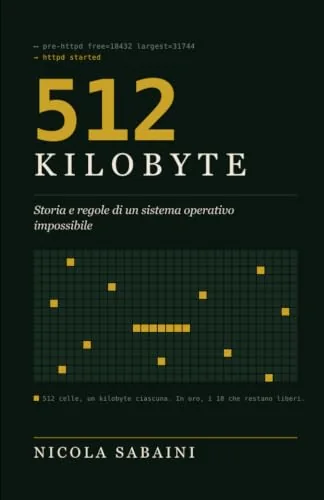
Not a manual, not a diary and not a technical report. It is the building of something that was not supposed to work: NucleoOS, a complete operating system on an ESP32-S3 with 512 kilobytes of RAM and no PSRAM. It is told from the inside, from the point of view of the machine that built it with me.
It opens with a command and an answer. esptool flash_id asks the chip who it
is and what it holds; the chip replies Features: 8MB Flash, no Embedded
PSRAM. The board was laid out for eight megabytes, the pads were there, and
it did not have them. Everything else starts from that no.
How it is built
Six parts, sixteen chapters, five appendices. The part titles already give the order in which the problems arrived: make it fit, make it think, make it speak, make it social and safe, make it ship, and finally take stock.
Every chapter opens with a BOOTSTEP: a sentence said out loud and a line of terminal output next to it. The first one is “I want a real OS, not a demo.” That format is what holds the book together, human intent on one side and what the machine actually answers on the other, and it is the same motif that sits on the cover.
Who is speaking
The narrator is not the author. It is the assistant that worked on the project with him, and the book is written from its point of view: the nights, the dead ends, the decisions made at three in the morning. There is an appendix called How to work with a machine like me, and the epilogue is a letter addressed to Nicola, Letter to an exhausted human.
It is a choice that could have turned into a gimmick and instead holds, because the machine doing the telling is the same one being built in the book: the chapter on the cascade that does not hallucinate and the chapter on the tiny-LLM wall are about how the narrator itself is made.
The rules
Appendix B collects every technical law in the book onto a single page. Some of them travel well beyond microcontrollers:
Do not count the free bytes. Count the largest contiguous block, at the worst moment.
An assistant that can say “I don’t know” is worth more than one that guesses.
An OS is its shared rules, not the number of its apps.
There is also an appendix called The Graveyard, which is exactly what it sounds like: the things that were tried and thrown away. In technical books it is the part that is almost always missing, and it is the one that saves the reader time.
Who it is for
For anyone writing code on hardware that does not forgive, and for anyone who wants to understand what actually happens when the memory is what it is and does not negotiate. You do not need a Cardputer on your desk: you need to have had, at least once, a constraint you could not buy your way around.
Written in Italian, on Amazon.it.
Written about this project
-
3 min read
A constraint is a specification
The cover of 512 KILOBYTE shows 512 memory cells, eighteen of them still free. It is not a metaphor. It is a readout.